
Finding Chanhassen Residents Carefully
Most Chanhassen parcels are in Carver County, where the practical current-record path begins with the property tools. An address can be checked in the county GIS, then tied to a parcel ID, taxpayer field, legal description, tax summary, plat, and recorded-document link. That process is stronger than guessing from a postal city. The eastern edge of Chanhassen includes 154 acres in Hennepin County, so county must be verified before a deed, assessment, court, or election request goes to Carver County.
A Chanhassen residents directory is not one official list. Property records describe an owner or taxpayer. Permit records identify an applicant, owner, contractor, or contact. A historical telephone entry is a dated publication clue. Keeping those labels intact prevents a search from turning several different roles into one unsupported claim.
- Keep the address as supplied, including unit, ZIP, and postal city, then confirm the parcel and county in the GIS.
- Record the parcel ID, legal description, taxpayer role, and retrieval date before following the Property Report Card or tax summary.
- Use the LandShark link for recorded land documents. Online coverage starts in 1988; earlier material is viewed at the Land Records counter.
- For an identified city matter, check public agendas, permits, or make a focused Minnesota Government Data Practices Act request through the City Clerk.
- For an earlier household, compare the available CCHS phonebooks, MNHS telephone collection, newspapers, plats, and census material.
Chanhassen Resident Records Desks
City Hall is useful for municipal data, permits, agendas, and local requests, but it is not the county land-records counter. Carver County offices in Chaska keep the main parcel, tax, land, vital, election, and district-court channels used for Chanhassen research. The city’s eastern county edge makes the first location check important. For a whole-street workflow, use the more detailed Chanhassen street directory route after the parcel is confirmed.
Carver Land Records & Vitals
600 East 4th Street
Chaska, MN 55318
(952) 361-1930
Carver County Elections
600 East 4th Street
Chaska, MN 55318
(952) 361-1941
Land Records is open weekdays from 8:00 a.m. to 4:30 p.m. and does not perform abstracting or lien searches for the public. Assessment, tax, election, and court questions use their own county contacts. The City Clerk accepts city data requests through its records portal when a city-held document is the target.
Chanhassen Parcel Records First
Carver County Property Information GIS accepts an address, a property ID, or an addition or plat name. After three characters, the GIS offers suggestions. A selected parcel can lead to taxpayer information, current and prior-year tax data, the Property Report Card, an available plat, a tax summary, and LandShark. An address can return more than one parcel, so the selected parcel should be checked before any name or legal description is copied.
| GIS field or link | What it contributes | Limit |
|---|---|---|
| Address, property ID, or plat | Finds the mapped parcel or candidate parcels | Suggestions are recommended, not a legal match |
| Taxpayer and taxpayer address | Shows the tax-record role and mailing information | Mailing address can differ from the property |
| Parcel ID, lot, block, plat | Links a map result to its legal subdivision description | Use the recorded document for a formal land record |
| Property links | Routes to report card, plat, tax summary, and LandShark | GIS is reference information, not a survey |
Carver’s public GIS schema also separates owner and taxpayer fields, street components, ZIP and ZIP+4, sale information, year built, and a homestead code. A homestead value can be an owner-occupancy clue, but it does not identify every member of a household. Map acreage can include mapped right-of-way or easement interests, particularly in post-2014 polygons, and can differ from a deed or survey.
Minnesota’s voter-registration lookup is shown below because its identity and address controls are a useful contrast to parcel-led research.
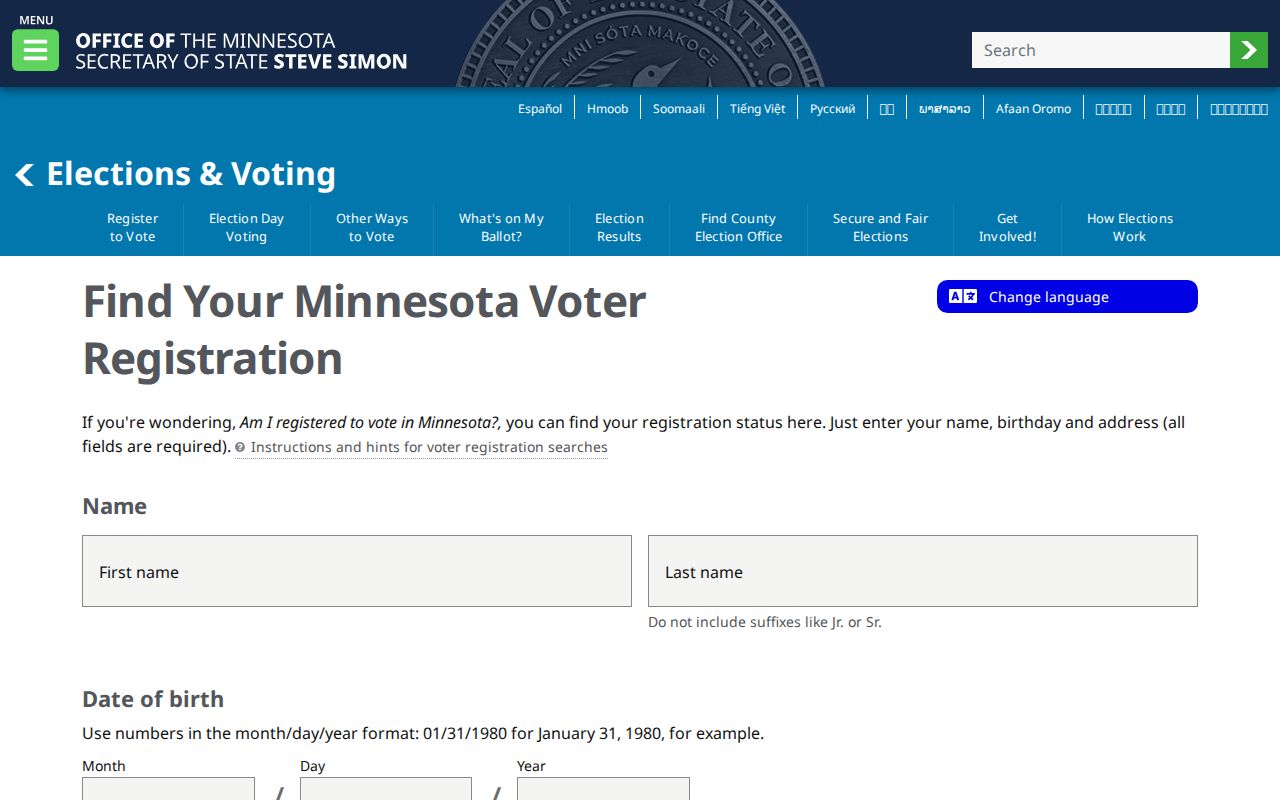
The screenshot shows the separate identity and address controls used by MNVotes. A voter confirmation is not a substitute for the parcel and recorded-document trail.
Current Chanhassen Resident Directories
Current sources answer narrow questions rather than listing every household. The county property tools offer address-centered ownership and taxpayer information. The city publishes a staff directory for public employees and uses its Clerk process for city data. State and county records can provide a confirmation or a request channel when the subject and lawful purpose fit the custodian’s rules.
| Chanhassen source | Role it records | Custodian | Access path |
|---|---|---|---|
| Parcel and tax record | Owner or taxpayer, parcel, legal description | Carver County | GIS, iasWorld route, assessment or tax office |
| Recorded land documents | Parties to deeds, mortgages, plats, and related instruments | Land Records & Vitals | LandShark from 1988; counter for older material |
| City staff directory | Public employee name, title, department, phone, and email | City of Chanhassen | Online civic directory |
| Voter information | Registration information under statutory limits | Minnesota and Carver County | MNVotes self-check or lawful public-list process |
| Permit and meeting records | Project participants or named public roles | City of Chanhassen | Online sources or targeted Clerk request |
A name-led search needs another kind of review. Court, vital, professional, business, and historical index records can support a fact about a person only when the name, date, address, and role line up. That one-person process remains distinct from a property or street search.
Chanhassen City Records by Address
The Chanhassen City Clerk manages agendas and minutes, city code and proposed ordinances, elections, licensing, transparency, and records requests. Public meeting materials can identify a person connected with a council action, development proposal, commission, license, or public comment. They provide civic context. A name in a meeting packet does not establish that the person lives at the street address discussed there.
Building and Engineering records add another address-based channel. Chanhassen issues and inspects building, plumbing, mechanical, fire-sprinkler, fire-alarm, and sewage-treatment permits. Its online permit instructions distinguish property selection from the project details that follow. The item can identify a project role, while a parcel record identifies the land reference. Compare both with the correct date.
City staff data is public-role information, not a household list. The city’s staff directory presents named employees, departments, titles, phones, and email. For an identified municipal record that is not online, use a focused request through the Clerk instead of treating city sources as a general residents directory.
Chanhassen Data Requests Stay Specific
Chanhassen’s data-request channel and Carver County’s public-data guidance implement the Minnesota Government Data Practices Act. Government data are presumed public unless a statute classifies them otherwise. A request should identify the record, say whether inspection, copies, or both are wanted, and give a useful address, date range, or record type. The office produces existing public data; it does not have to create a new report or answer a broad question in place of records.
Carver County accepts a written Chapter 13 request by mail, fax, or email to the right data-practices contact. Inspection is free. Copies can carry actual search, retrieval, copy, and transmittal costs, while eligible electronic data should be supplied in the format maintained when reasonably possible. If data are withheld, the county must state the legal basis and can certify that denial on request. After notice that material is ready, five business days without arranging inspection or payment can be treated as abandonment.
Start with the City Clerk for city-held permits, minutes, or data. Use Land Records, Assessment, Elections, Court Administration, or the Sheriff Records Unit for county-held material. The defined custodian and narrow record description make a request more useful and protect both public access and private data classifications.
Chanhassen Voter Data Has Limits
MNVotes is a self-lookup service. It asks for first name, last name, birth date, and an address route using ZIP or county. The county route then asks for county, city or township, house number, street, and an optional unit. The service says registration information updates nightly, although an official change can take up to 14 days to appear. A no-match is not proof that a person is not registered.
Minnesota Statutes section 201.091 governs a separate public voter-information list. It has an identification and written lawful-use requirement, and the list may not be republished online as a searchable directory. Its allowed fields and access limits make it unsuitable for creating a general Chanhassen roster. Safe at Home participants have protected location data and must never be reverse-engineered from a public source.
The MCRO case-search form is pictured here. Its fields make clear why a direct record search differs from a public name-and-address directory.
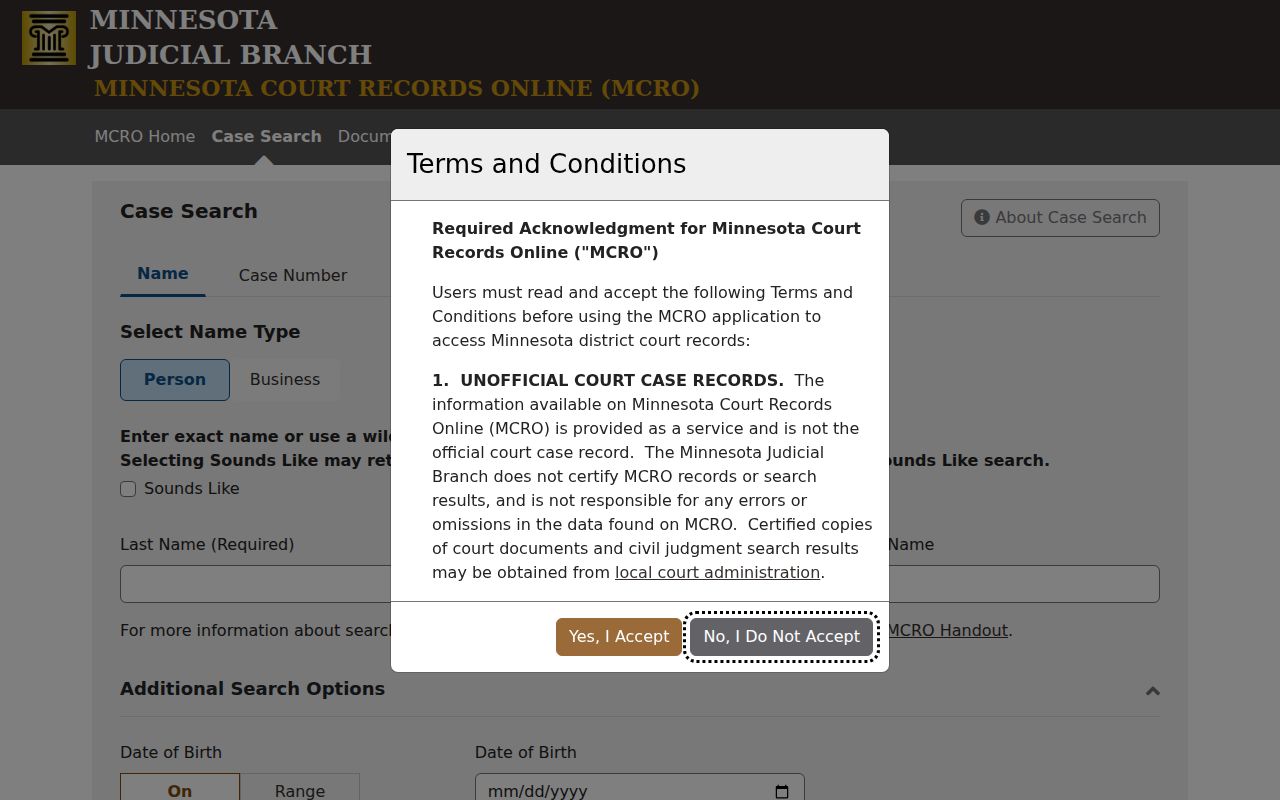
MCRO uses another set of optional identifiers, including name, case number, citation, attorney, filing date, category, and county. A court party is a record role, not a resident label.
Chanhassen Court Names Need Context
Minnesota Court Records Online searches public district-court information for Carver County and statewide. Exact-name searching, a trailing wildcard after two characters, and Sounds Like searches are available, but wildcard and Sounds Like cannot be combined. Run a full name, no-middle-name version, middle initial, and supported spelling variation as separate searches. Case searches can also be narrowed by date, category, status, and county location.
Remote MCRO access omits some material available on courthouse terminals. Pending criminal, traffic, and petty-misdemeanor cases without a conviction do not appear in a defendant-name search, and sealed, expunged, destroyed, juvenile, or other nonpublic material may be absent. Carver County Court Administration at the Justice Center handles local copy and certification requests. A case category is not an outcome, and an equal name or even equal birth date does not establish identity.
Minnesota’s vital-records forms are included for their requester and eligibility controls. They help distinguish a controlled public record request from a broad personal-profile search.
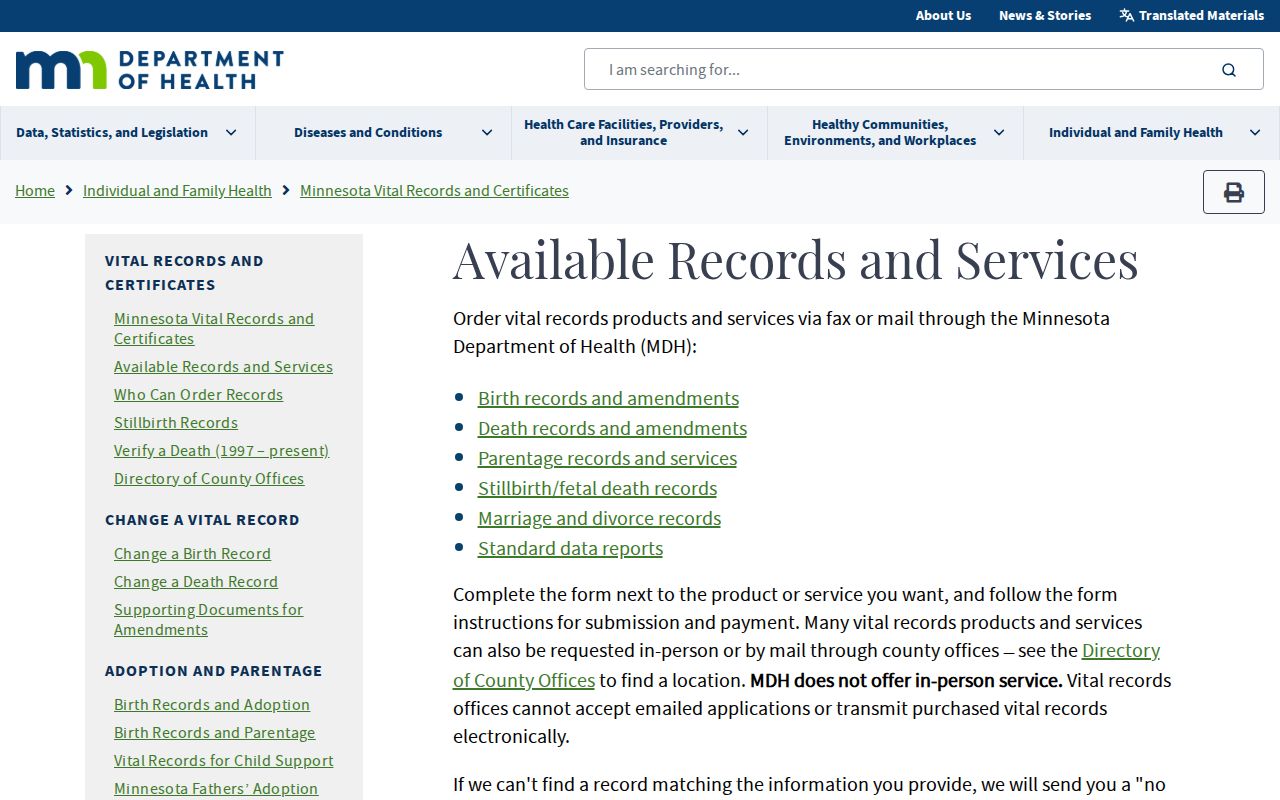
Vital-record forms require a particular event and requester route. They do not turn a name search into unrestricted access to certified records.
Chanhassen Vital Record Paths
Carver County Land Records & Vitals keeps county land and vital functions at 600 East 4th Street in Chaska. Birth, death, and marriage records follow different public and eligibility rules. A marriage certificate comes from the county where the license application was made, while MOMS is a public index that can identify the issuing county. Minnesota Department of Health availability rules also distinguish a public informational index from a certified record.
Statewide birth availability is 1900-present and death availability is 1908-present, with older events handled by the county of occurrence. The online Death Verification Service is for 1997-present exact matches and returns a decedent name, date of death, and state file number when matched. Carver’s earlier local indexes at CCHS are discovery leads, not substitutes for a certificate. A current person’s residence should never be inferred simply from a family-event record.
Minnesota’s DOC Locator is represented below. Its limited adult-custody search illustrates why a state status record has a different purpose from a vital-record request.
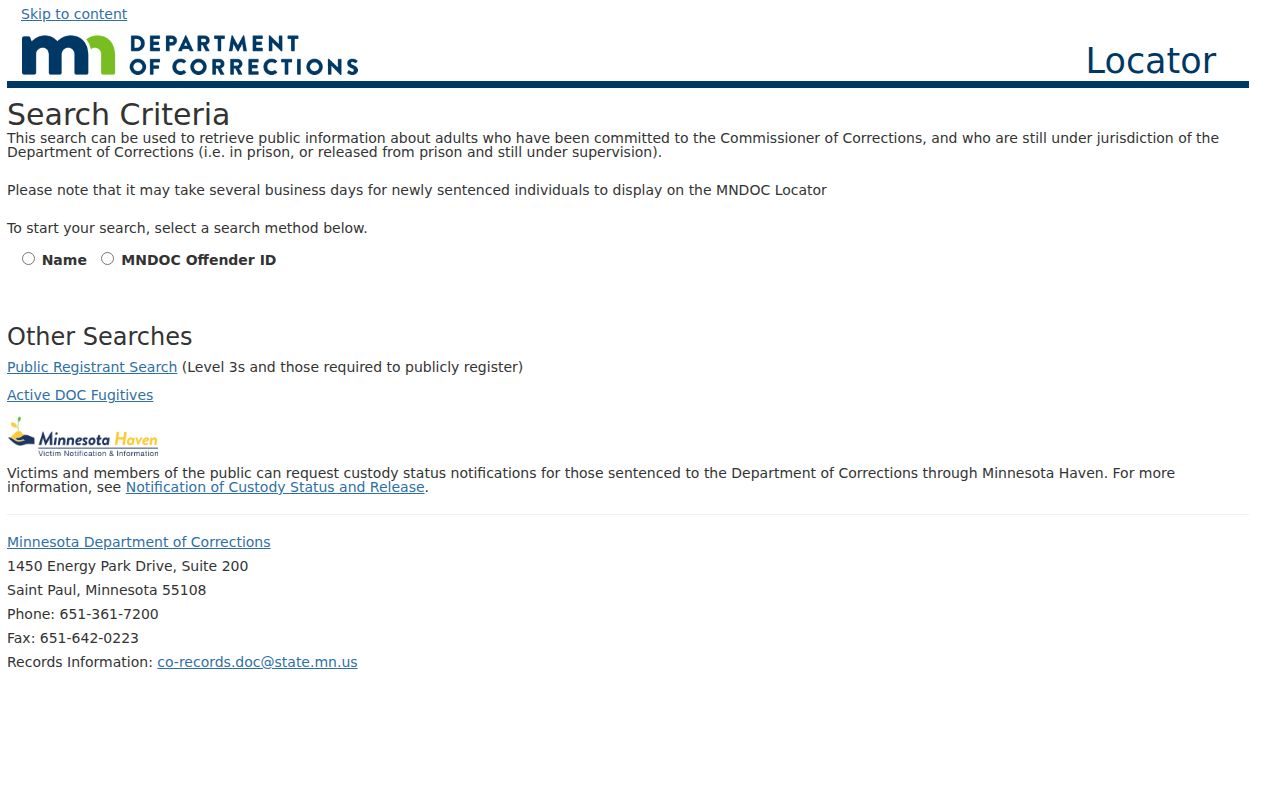
The DOC Locator has first-name, last-name, and MNDOC ID search routes for adults under DOC jurisdiction. Its result is time-sensitive and never establishes a Chanhassen address.
Chanhassen Records Stay Role-Specific
The Minnesota DOC Locator, sheriff materials, professional-license searches, and business filings can all be legitimate official channels for a specific record purpose. Each source defines a narrow role. A correctional record concerns custody or status, a license concerns an authorization, and a filing address may be a registered office rather than a person’s home. Carver Sheriff report requests go through the Records Unit, with nonpublic portions redacted under the applicable law.
Use the least invasive source that answers the question. Record the source title, URL, custodian, date, relevant role, address type, and limitation. That recordkeeping helps separate a verified parcel or official event from a same-name lead. It also makes a correction or a request to the right office much easier.
- Parcel
- A county property identifier that anchors land, tax, plat, and map research.
- Index
- A finding tool that points to a record; it is not always the record image or a certified copy.
- Roll
- A list kept for one administrative purpose, such as assessment or registration, with its own rules.
- Criss-cross directory
- A street-order directory format. No verified Chanhassen reverse-directory run was located in the inspected sources.
Historical Chanhassen Resident Directories
Earlier Chanhassen research needs both a date and the historical place name. The village incorporated in 1896, and the modern city formed in 1967 by merging the village and township. Older deeds, newspapers, census material, and directories can use a township or village label instead of the current city name. CCHS holds census microfilm from 1850 through 1930, naturalization material from 1862 through 1943, local vital indexes, church and cemetery records, newspapers, photographs, and historic plats.
The CCHS phonebook list covers 1984-1996, 2008-2011, 2013-2014, 2018, and 2020-2021, with real gaps between runs. MNHS also has an open Carver telephone-directory collection dated from 1939 onward. Its white pages can include names, phone numbers, and street addresses, while yellow pages list subjects. The detailed city and shelf inventory must be checked before assuming a Chanhassen volume exists. The Chanhassen city directory page keeps the collection-level details together.
Chanhassen Address History Matters
Chanhassen has three city-mapped ZIP codes, 55317, 55318, and 55331. Postal city strings can be Chanhassen, Chaska, or Excelsior. In 2025 the City asked USPS to accept Chanhassen for 55318 and 55331, while 55317 remained the default Chanhassen postal label. Preserve postal city, municipality, ZIP, county, and parcel ID separately when a search fails or a record looks inconsistent.
That postal mismatch is a useful local warning. It does not change municipal boundaries or decide the county custodian. The city’s 2026 notice about a West 94th Street right-of-way vacation and a Kiowa Trail address requirement is another reminder to search former and current strings, then anchor the result to the parcel and legal description. Note: A map label or postal city is geographic context, not proof that a person lives there.