
Finding Chanhassen Residents Carefully
Start with geography. Most Chanhassen parcels sit in Carver County, so the property tools there handle the current-record work: look up the address in the county GIS, tie it to a parcel ID, then follow the taxpayer field, legal description, tax summary, plat, and recorded-document link. That path beats guessing from a postal city name. It matters here. The eastern edge of Chanhassen includes 154 acres in Hennepin County, so the county must be confirmed before any deed, assessment, court, or election request goes to Carver.
A Chanhassen residents directory is not one official list, and treating it that way causes errors. Property records name an owner or taxpayer. Permit records name an applicant, owner, contractor, or contact. A historical telephone entry is a dated publication clue and nothing more. Keeping each label intact stops a search from collapsing several distinct roles into one unsupported claim about a person.
- Keep the address as supplied, including unit, ZIP, and postal city, then confirm the parcel and county in the GIS.
- Record the parcel ID, legal description, taxpayer role, and retrieval date before following the Property Report Card or tax summary.
- Use the LandShark link for recorded land documents. Online coverage starts in 1988; earlier material is viewed at the Land Records counter.
- For an identified city matter, check public agendas, permits, or make a focused Minnesota Government Data Practices Act request through the City Clerk.
- For an earlier household, compare the available CCHS phonebooks, MNHS telephone collection, newspapers, plats, and census material.
Chanhassen Resident Records Desks
City Hall handles the municipal side of things in Chanhassen. Permits, agendas, and local requests all belong there. But land records live elsewhere. The parcel, tax, vital, election, and district-court channels that matter for Chanhassen research sit with Carver County in Chaska. The city straddles a county line on its eastern edge. So confirming which county holds a record should come before anything else. Once the parcel is settled, the Chanhassen street directory route carries a whole-street workflow further. City Hall could never take it that far.
Carver Land Records & Vitals
600 East 4th Street
Chaska, MN 55318
(952) 361-1930
Carver County Elections
600 East 4th Street
Chaska, MN 55318
(952) 361-1941
Land Records keeps weekday hours of 8:00 a.m. to 4:30 p.m. The desk does no abstracting or lien searches for the public. Assessment, tax, election, and court questions each route to their own county contacts. When a city-held document is the target, the City Clerk handles it. That office takes data requests through its records portal.
Chanhassen Parcel Records First
Carver County Property Information GIS takes three kinds of input: an address, a property ID, or an addition or plat name. Type three characters and suggestions appear. Selecting a parcel opens taxpayer information, current and prior-year tax data, the Property Report Card, any available plat, a tax summary, and LandShark. One caution applies. A single address can return more than one parcel, so verify the chosen parcel before copying any name or legal description into a residents directory or resident lookup.
| GIS field or link | What it contributes | Limit |
|---|---|---|
| Address, property ID, or plat | Finds the mapped parcel or candidate parcels | Suggestions are recommended, not a legal match |
| Taxpayer and taxpayer address | Shows the tax-record role and mailing information | Mailing address can differ from the property |
| Parcel ID, lot, block, plat | Links a map result to its legal subdivision description | Use the recorded document for a formal land record |
| Property links | Routes to report card, plat, tax summary, and LandShark | GIS is reference information, not a survey |
Carver's public GIS schema splits out owner and taxpayer fields. It also covers street components, ZIP and ZIP+4, sale information, year built, and a homestead code. A homestead value hints at owner occupancy. It does not identify every member of a household, though. So a Chanhassen residents directory built on parcels alone will miss people. Map acreage carries its own quirk. Post-2014 polygons can include mapped right-of-way or easement interests, and the figure can differ from what a deed or survey shows.
Minnesota's voter-registration lookup appears here for a reason. Its identity and address controls offer a useful contrast to parcel-led research.
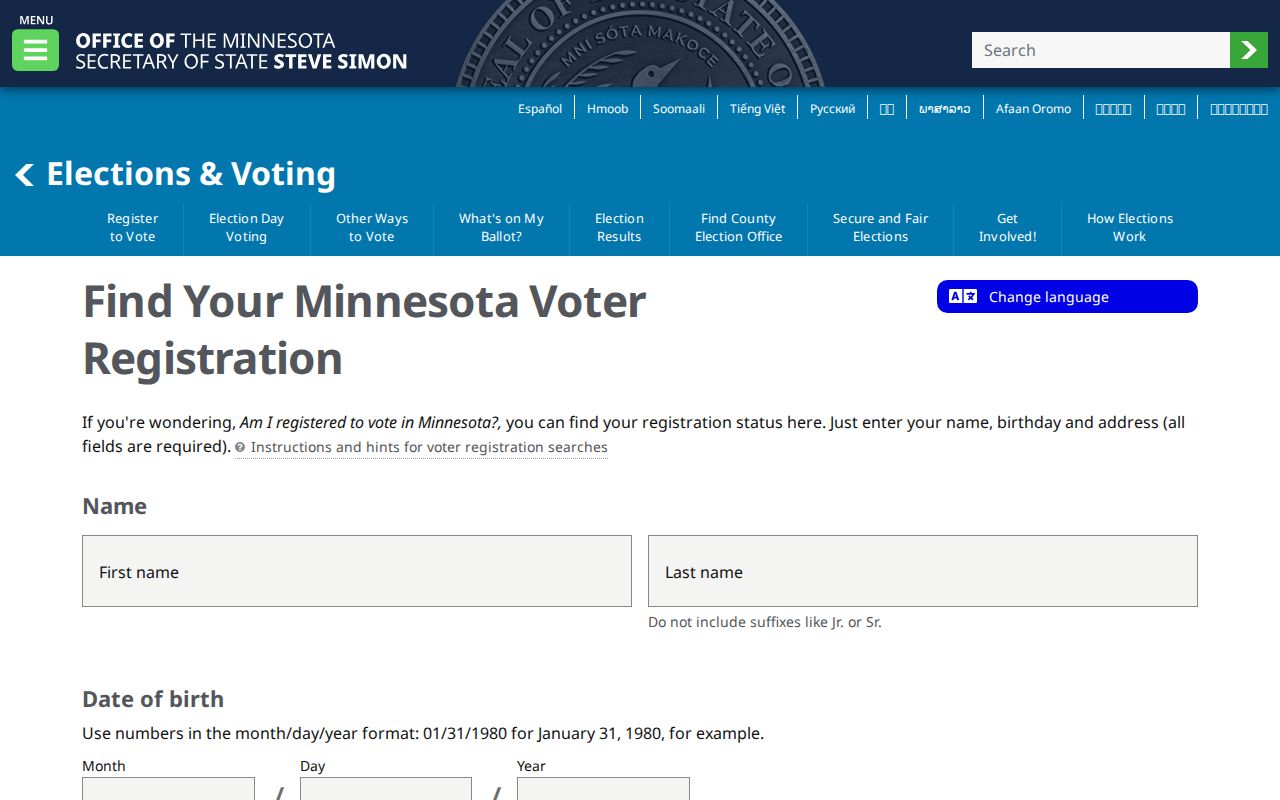
The MNVotes lookup keeps its identity fields and its address fields apart. A voter confirmation alone never replaces the parcel rolls or the recorded-document trail held by the county recorder and assessor.
Current Chanhassen Resident Directories
None of the current sources lists every household. Each one answers a narrower question. The county property tools anchor on an address and return ownership plus taxpayer details. The city publishes a staff directory, but that covers public employees. Its Clerk handles requests for other city data. When a lawful purpose fits a custodian's rules, state and county records offer a confirmation. They also give a formal request channel.
| Chanhassen source | Role it records | Custodian | Access path |
|---|---|---|---|
| Parcel and tax record | Owner or taxpayer, parcel, legal description | Carver County | GIS, iasWorld route, assessment or tax office |
| Recorded land documents | Parties to deeds, mortgages, plats, and related instruments | Land Records & Vitals | LandShark from 1988; counter for older material |
| City staff directory | Public employee name, title, department, phone, and email | City of Chanhassen | Online civic directory |
| Voter information | Registration information under statutory limits | Minnesota and Carver County | MNVotes self-check or lawful public-list process |
| Permit and meeting records | Project participants or named public roles | City of Chanhassen | Online sources or targeted Clerk request |
A search led by a person's name works differently. Court, vital, professional, business, and historical index records can support a fact about someone only when the name, date, address, and role all line up. That one-person lookup stays separate from a property or street search. In Chanhassen, the two paths rarely overlap.
Chanhassen City Records by Address
The Chanhassen City Clerk manages agendas and minutes. The Clerk also handles city code, proposed ordinances, elections, licensing, transparency, and records requests. Public meeting materials can connect a person to a council action or a development proposal. They can also connect a person to a commission, a license, or public comment. That is civic context. A name inside a meeting packet does not prove the person lives at the street address being discussed. Building and Engineering records open another address-based channel. Chanhassen issues and inspects building, plumbing, mechanical, fire-sprinkler, fire-alarm, and sewage-treatment permits. The online permit instructions separate property selection from the project details that come next. A permit names a project role; a parcel record names the land reference. Check both against the right date before drawing any conclusion about who lives there. City staff data describes public roles, not households. The staff directory lists named employees with departments, titles, phones, and email. For an identified municipal record that never went online, file a focused request through the Clerk. Treat these city sources as civic records rather than a Chanhassen residents directory.
Chanhassen Data Requests Stay Specific
Chanhassen’s data-request channel works alongside Carver County’s public-data guidance under the Minnesota Government Data Practices Act. The rule is simple. Government data are presumed public unless a statute says otherwise. Ask for the record by name. Say whether you want to inspect it, get copies, or both. Include an address, date range, or record type that narrows the hunt. The office must produce the data it already holds. It does not have to build a new report. Nor must it answer an open-ended question where a records request belongs.
Carver County takes a written Chapter 13 request by mail, fax, or email. It goes to the proper data-practices contact. Looking is free. Copies may carry actual search, retrieval, copy, and transmittal costs. Electronic data should arrive in the maintained format when that is reasonably possible. If the county withholds anything, it must state the legal basis. It will certify a denial on request. One caution matters: once you hear the material is ready, five business days without arranging inspection or payment can count as abandonment.
City permits, minutes, and other city-held data start with the City Clerk. County material goes to Land Records, Assessment, Elections, Court Administration, or the Sheriff Records Unit. Naming the right custodian and describing the record narrowly serves everyone. It speeds the request and protects the private-data classifications that sit beside public access.
Chanhassen Voter Data Has Limits
MNVotes is a self-lookup service. It asks for first name, last name, birth date, and an address route using ZIP or county. The county route then asks for county, city or township, house number, street, and an optional unit. The service says registration information updates nightly, although an official change can take up to 14 days to appear. A no-match is not proof that a person is not registered.
Minnesota Statutes section 201.091 governs a separate public voter-information list. It has an identification and written lawful-use requirement, and the list may not be republished online as a searchable directory. Its allowed fields and access limits make it unsuitable for creating a general Chanhassen roster. Safe at Home participants have protected location data and must never be reverse-engineered from a public source.
The MCRO case-search form is pictured here. Its fields make clear why a direct record search differs from a public name-and-address directory.
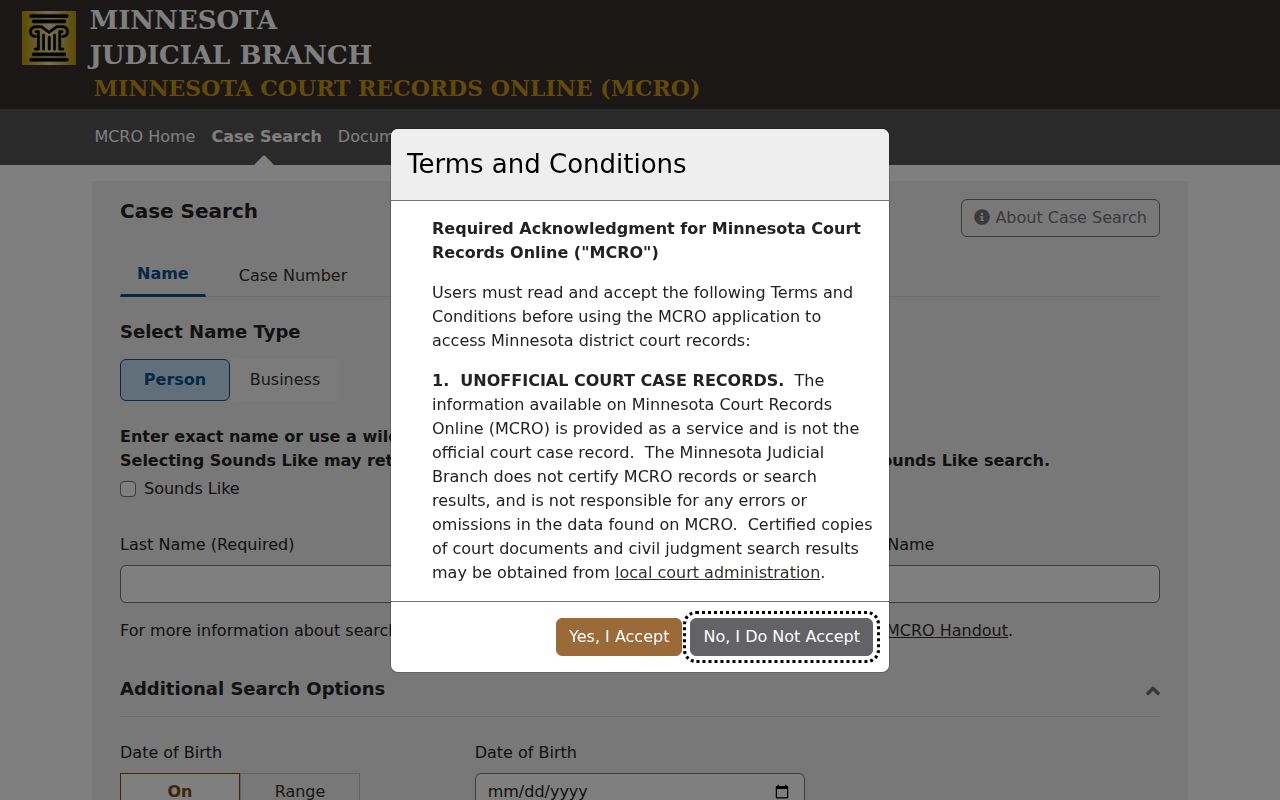
MCRO takes a different set of optional identifiers. Name, case number, citation, attorney, filing date, category, and county can each be searched, but a court party is a record role, not a resident label.
Chanhassen Court Names Need Context
Minnesota Court Records Online covers public district-court information for Carver County and statewide. Exact-name searching is available. So is a trailing wildcard after two characters and a Sounds Like option, though wildcard and Sounds Like cannot combine. Run a full name, a no-middle-name version, a middle initial, and supported spelling variations as separate searches. Date, category, status, and county location can narrow results further.
Remote MCRO access leaves out material a courthouse terminal shows. Pending criminal, traffic, and petty-misdemeanor cases without a conviction never appear in a defendant-name search. Sealed, expunged, destroyed, juvenile, and other nonpublic material may be absent too. Local copy and certification requests go to Carver County Court Administration at the Justice Center. Keep the context straight. A case category is not an outcome, and an equal name or even equal birth date does not establish identity.
Minnesota’s vital-records forms appear for their requester and eligibility controls. They show the line between a controlled public record request and a broad personal-profile search.
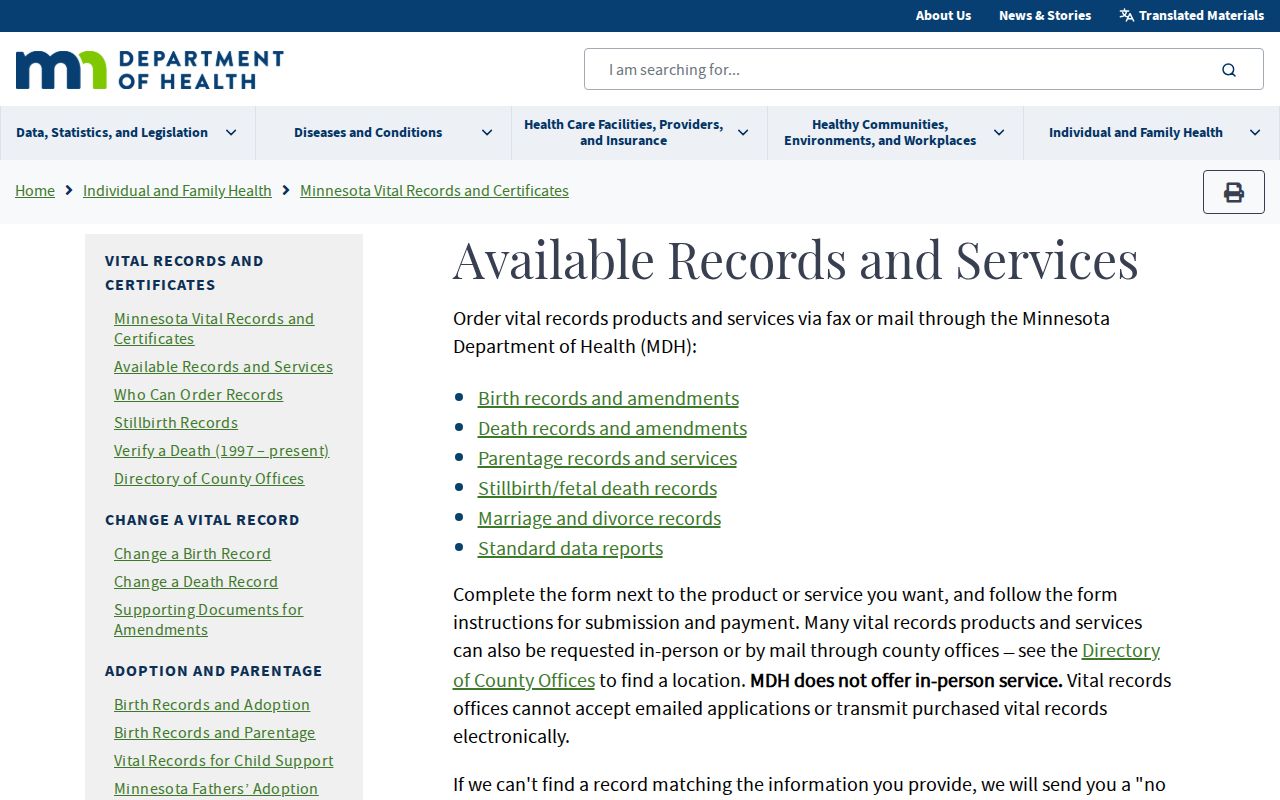
Vital-record forms demand a particular event and a defined requester route. No name search converts them into unrestricted access to certified records.
Chanhassen Vital Record Paths
Carver County Land Records & Vitals keeps county land and vital functions. Its office sits at 600 East 4th Street in Chaska. Birth, death, and marriage records each follow their own public and eligibility rules. A marriage certificate comes from the county where the license application was made. MOMS, a public index, can identify that issuing county. Minnesota Department of Health availability rules likewise separate a public informational index from a certified record.
Statewide birth coverage runs 1900-present and death coverage 1908-present. Older events fall to the county of occurrence. The online Death Verification Service covers 1997-present exact matches. It returns a decedent name, date of death, and state file number when it hits. Carver’s earlier local indexes at CCHS are discovery leads, not substitutes for a certificate. One boundary holds firm: never infer a current person’s residence from a family-event record.
Minnesota’s DOC Locator is shown below. Its narrow adult-custody search shows why a state status record serves a different purpose. That differs from a vital-record request.
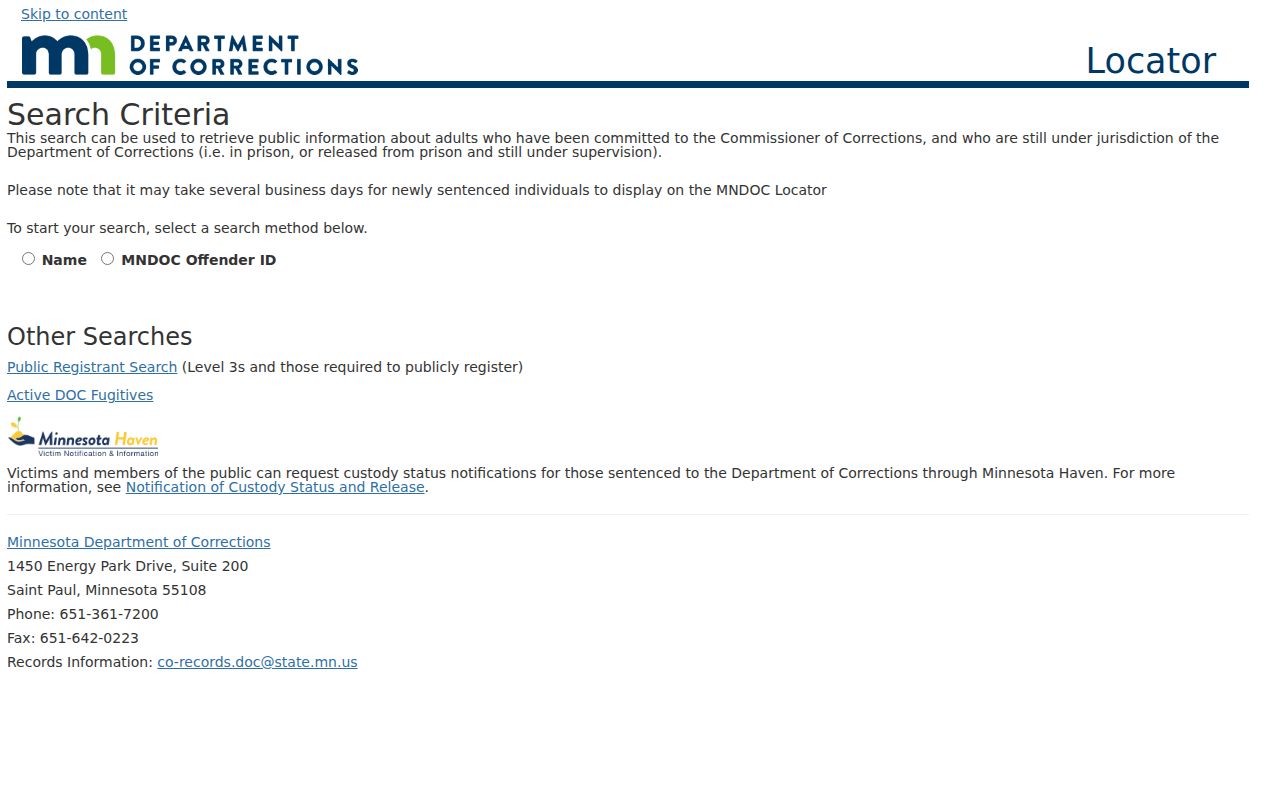
The DOC Locator searches first name, last name, and MNDOC ID for adults under DOC jurisdiction. Results are time-sensitive and never establish a Chanhassen address.
Chanhassen Records Stay Role-Specific
Every official channel serves one purpose. The Minnesota DOC Locator answers custody questions, professional-license searches confirm an authorization, and business filings may point to a registered office rather than anyone's home. Sheriff materials fill their own narrow role. Requests to the Carver Sheriff go through the Records Unit, which redacts nonpublic portions under the applicable law.
Pick the least invasive source that answers your question. A city directory lookup rarely needs a correctional record. Keep a note of the source title, URL, custodian, date, and any limitation you encounter. That habit separates a verified parcel or official event from a mere same-name lead. It also smooths any later correction request.
- Parcel
- A county property identifier that anchors land, tax, plat, and map research.
- Index
- A finding tool that points to a record; it is not always the record image or a certified copy.
- Roll
- A list kept for one administrative purpose, such as assessment or registration, with its own rules.
- Criss-cross directory
- A street-order directory format. No verified Chanhassen reverse-directory run was located in the inspected sources.
Historical Chanhassen Resident Directories
Older Chanhassen research needs two anchors: a date and the historical place name. The village incorporated in 1896. The modern city formed in 1967 by merging the village with the township. Deeds, newspapers, census material, and early street directories may carry a township or village label instead of the current name. CCHS holds census microfilm from 1850 through 1930, naturalization material from 1862 through 1943, local vital indexes, church and cemetery records, photographs, and historic plats.
The CCHS phonebook list covers 1984-1996, 2008-2011, 2013-2014, 2018, and 2020-2021, with real gaps between runs. MNHS keeps an open Carver telephone-directory collection dated from 1939 onward. White pages there can include names, phone numbers, and street addresses; yellow pages list subjects by trade. Check the detailed city and shelf inventory before assuming a Chanhassen volume exists. The Chanhassen city directory page keeps the collection-level details together.
Chanhassen Address History Matters
Chanhassen maps to three city ZIP codes: 55317, 55318, and 55331. Postal city strings can read Chanhassen, Chaska, or Excelsior. In 2025 the City asked USPS to accept Chanhassen for 55318 and 55331. Meanwhile, 55317 kept its default Chanhassen postal label. That mismatch is a useful local warning. It changes nothing about municipal boundaries or the county custodian. When a resident lookup fails, preserve key fields separately. Keep postal city, municipality, ZIP, county, and parcel ID apart.
Address changes cut the other way too. The city's 2026 notice covered a West 94th Street right-of-way vacation. It also covered a Kiowa Trail address requirement. Both are reasons to search former and current street strings before anchoring a result to the parcel and legal description. Note: A map label or postal city is geographic context, not proof that a person lives there.